
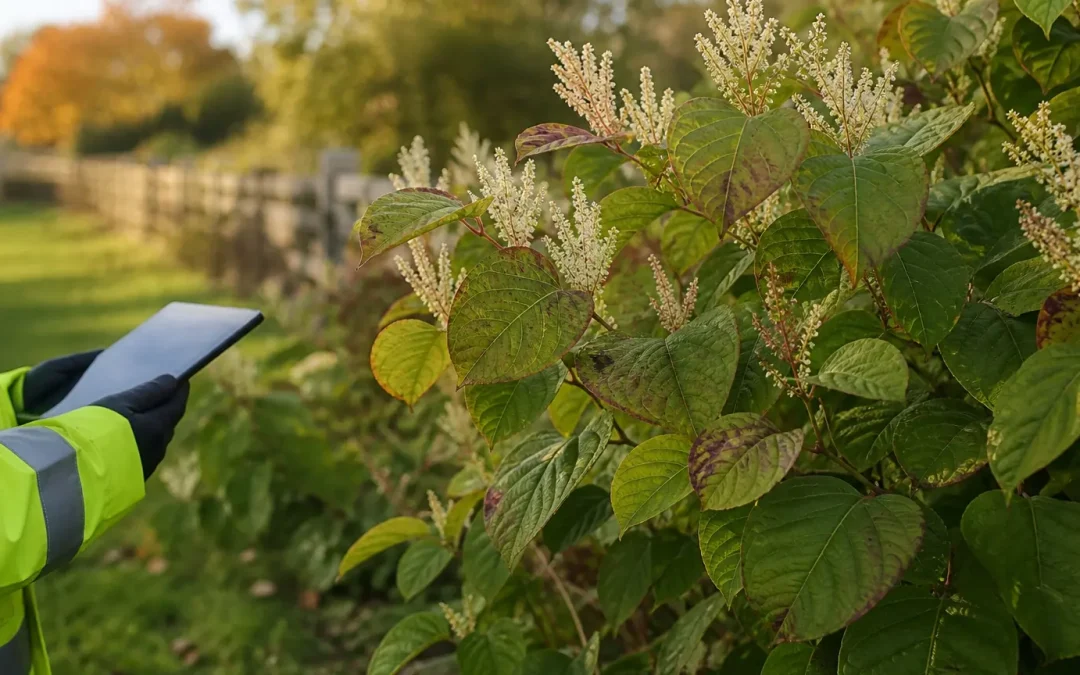
By September, Japanese knotweed has usually reached mature height and may carry sprays of small creamy-white flowers. The stand is often easier to see as a whole than it was in spring, which makes early autumn a useful time to photograph, map and assess suspected growth before winter dieback changes the picture.
A September survey is not a promise that every treatment must begin immediately. Its value is that it captures visible evidence while stems, leaves, flowers and the shape of the stand can still be examined together.
Mature growth provides more context
During a survey, the specialist will look for a combination of features rather than relying on a single leaf or an online photograph. These can include:
- red- or purple-speckled stems with distinct nodes;
- alternating leaves and a characteristic branching pattern;
- creamy flower clusters in late summer or early autumn;
- dense growth arising from a defined area; and
- older brown canes or a substantial crown that may indicate an established stand.
Lookalike plants still occur, and flowering alone is not conclusive. Accurate identification remains the first decision.
Map what is visible before it disappears
Winter does not kill the rhizome. The green growth dies back, leaving brown canes that can become brittle, collapse or be cleared during routine garden work. That can remove useful evidence of the stand’s summer extent.
Before the leaves fall:
- Photograph the stand from several fixed points.
- Measure or sketch its visible footprint without entering it unnecessarily.
- Record nearby boundaries, drains, paths, structures and planned works.
- Note any separate shoots away from the main stand.
- Keep historic photographs, surveys and treatment records together.
These records help a specialist compare visible growth with the site layout and design an appropriate management plan.
Treatment should follow the site objective
Late summer and early autumn can be an important treatment window for suitable systemic herbicides. Natural Resources Wales, for example, advises post-flowering late-summer or autumn glyphosate application. That is not a universal DIY calendar: only authorised products may be used, label conditions and weather must be followed, and professional products require a trained user with the appropriate certificate. Excavation depends on the likely rhizome extent, access, waste controls and future land use.
The important question is not simply, “Can it be sprayed now?” It is, “What outcome does this property need, and what evidence and monitoring will show that the plan is working?”
For a quiet garden area, a staged treatment programme may be appropriate. A sale, extension, drainage project or development timetable may require a different route. A professional survey should explain the options and their practical consequences rather than forcing every site into the same method.
Keep autumn maintenance controlled
Do not strim, flail, dig or move soil through a suspected stand while identification is pending. If contractors are maintaining the rest of the property, show them the area and agree a no-entry zone. Keep mower decks, boots and tools away from it.
Japanese knotweed material that is discarded may be controlled waste. Do not place it in ordinary garden waste or move it to another property. Disposal and on-site treatment requirements differ across the UK and should be checked with the relevant regulator.
Turn a visible stand into a documented plan
Elcot Environmental can identify suspected knotweed, survey its setting and recommend treatment or removal around the property objective. Its residential route includes mortgage-approved treatment plans and a 10-year insurance-backed guarantee, with eligibility and terms confirmed for the property. Customers should still check the documents required by their own lender, valuer and solicitor. Commercial sites have a separate service route.
For England or Scotland, call 01793 700100. For Wales, call 01792 930199, or contact Elcot online.
Recent Comments